




RPA and AI: The Key to Automation in Modern Enterprises
Discover how RPA and AI are revolutionizing automation in IT companies. Learn about key benefits, processes to automate, and examples of business success.
Witold Krzyk26 November 2024
Empower your business with Virtual Reality setting
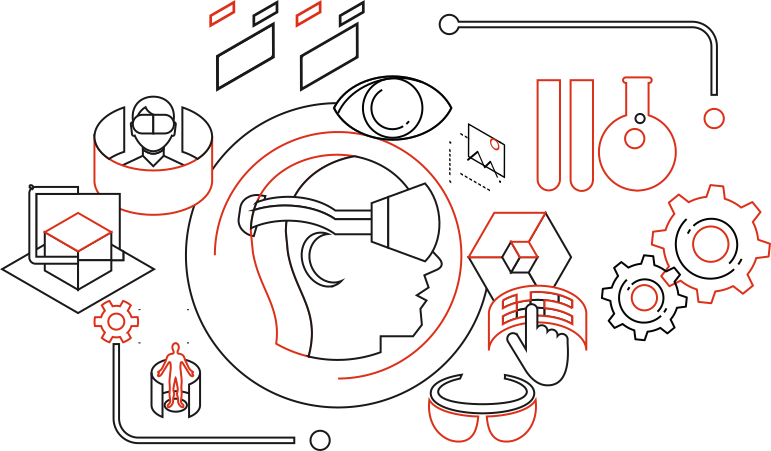
Augmented reality, virtual reality and mixed reality can change how people interact with products, spaces, data and instructions.
These technologies can support customer-facing experiences, such as virtual product previews, interactive showrooms, real estate presentations or training simulations. They can also improve internal work by giving employees hands-free access to information, digital instructions and real-time support.
In laboratories, logistics, manufacturing and construction, AR and mixed reality can help teams follow procedures, visualise data, collaborate remotely and reduce the need to switch between physical tasks and separate screens.
SoftwareHut can help you design, develop and integrate AR/VR solutions that match your business goals, users and technical environment.
Use AR, VR and mixed reality to create more interactive experiences and improve the way people work.

Brand visibility

Digital experience

Customer engagement
Improved processes

Collaboration

Reduced errors

AR and VR should make complex information easier to experience
They help companies present products, train teams and explain processes in a more interactive way. The business value comes from turning abstract ideas into something people can see, test and understand before making decisions.
What AR/VR expertise can we provide?
We support AR/VR projects from idea validation to implementation and further development.

Custom Solutions
We adapt the solution to your business goals, users and existing systems.

Project Quality
We build and test the software so it meets the agreed requirements and technical standards.

Proven technology stack
We select tools and technologies that fit the project’s purpose, devices and long-term plans.

The award recognises partners that help organisations accelerate digital transformation with mixed reality technologies and Azure services.
What is possible with AR/VR development?
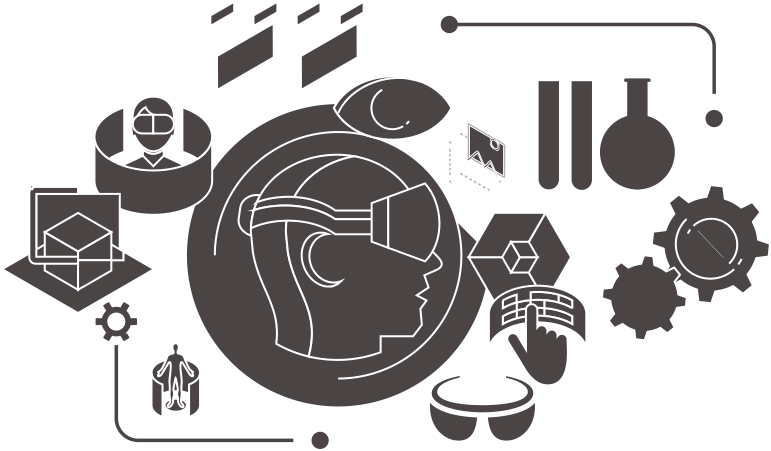
AR, VR and mixed reality are no longer limited to gaming and entertainment. They are increasingly used in retail, healthcare, education, manufacturing, logistics, real estate and internal training.
In retail, AR can help customers see how a product may look in their own environment before they buy it. In real estate, virtual tours can make it easier to present properties remotely. In training, immersive simulations can help users practise procedures in a controlled digital environment.
For businesses, AR and mixed reality can also support daily operations. Workers can receive step-by-step instructions, access data in their field of view or collaborate with remote experts while staying focused on the task.
The right use case depends on what the solution should help users see, understand, practise or complete.
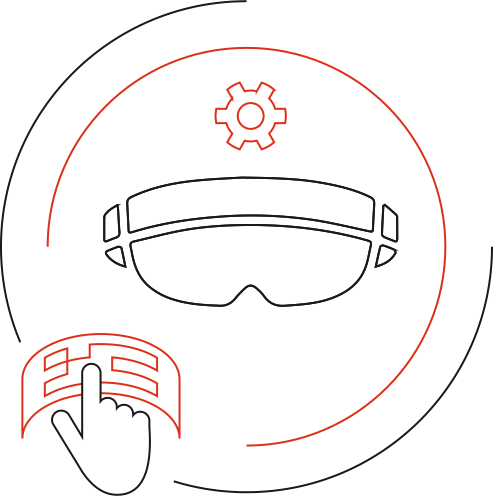
AR and VR projects can use different tools depending on the target device, required features and level of interaction.
For mobile AR, Apple ARKit and Google ARCore can support applications that use smartphone cameras, sensors and screens to place digital elements in the physical environment.
For headset-based experiences, the project may involve devices such as Microsoft HoloLens, Meta Quest or other AR/VR hardware. These solutions are often used when users need a more immersive or hands-free experience.
Development may also involve engines such as Unity, 3D modelling tools, cloud services, backend systems, mobile applications and integrations with business software.
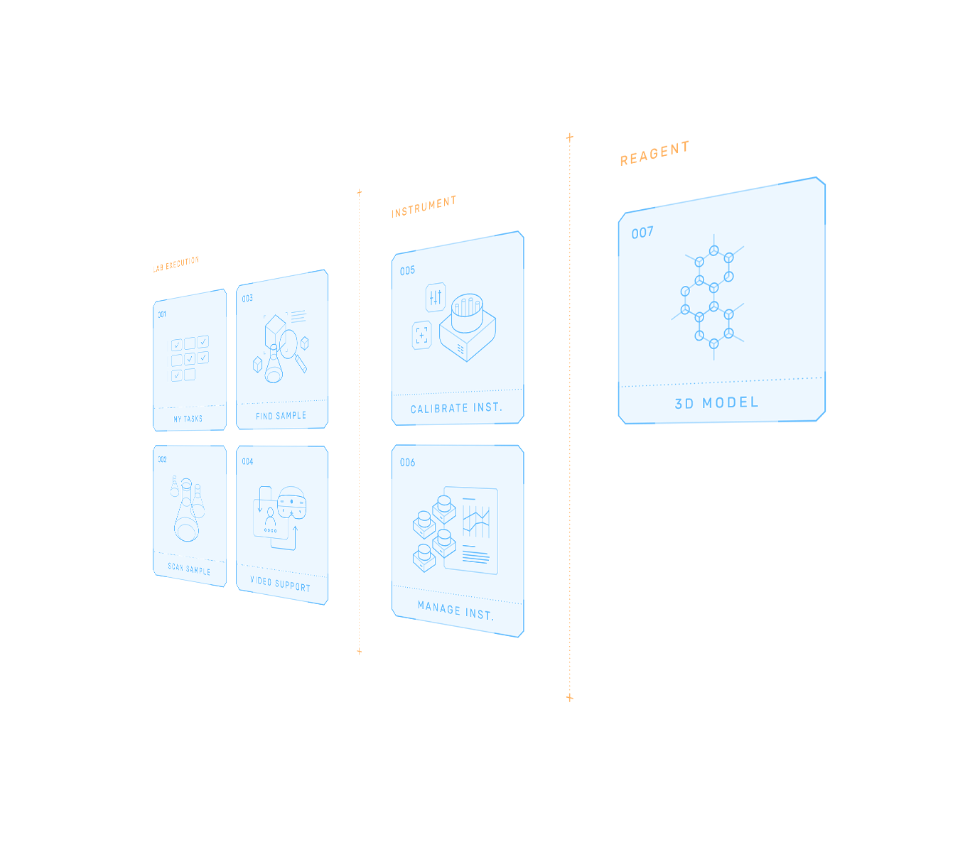
Have you heard about Holo4Labs?
SoftwareHut developed Holo4Labs, a mixed reality interface that connects Microsoft HoloLens 2 with Thermo Scientific™ SampleManager LIMS™.
The solution helps scientists and researchers work with laboratory data through a mixed reality interface. Users can scan samples, enter required information, view tasks, follow procedures and collaborate through video support.
Holo4Labs was designed to reduce manual work, improve access to information and support safer, more efficient laboratory processes.
How to choose the right AR/VR development team?
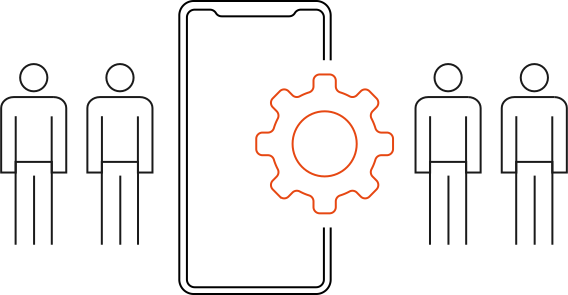
An AR/VR project needs a team that understands software development, user experience, 3D environments and the devices the product will run on.
Before choosing a partner, review their experience with similar projects, target hardware, integrations, testing and long-term maintenance. The team should be able to explain which technology fits your use case and where AR, VR or mixed reality will provide real value.
Some companies need specialists who can join an internal team. Others need a partner that can take responsibility for the complete project, from requirements and design to development and support.
SoftwareHut can support both models. We can provide selected specialists or deliver the full AR/VR project.
We follow a clear process to organise and deliver your AR/VR project.

Requirements
We analyse the business goal, users, target devices, technical environment and expected outcomes.
Development
We design, build, test and implement the AR/VR solution based on the agreed scope and technology approach.

Support
We maintain the solution, resolve technical issues and develop further improvements after launch.
How much does AR/VR development cost?
The cost of AR/VR development depends on the project scope, required devices, level of interaction, 3D assets, integrations, team structure and expected delivery time.
A simple mobile AR feature will have a different budget from a mixed reality system connected to business software and designed for daily operational use.
The pricing model also affects the final cost. A fixed-price model may work when the scope and acceptance criteria are clearly defined. Time and materials is usually better when the product requires testing, iteration or changes during development.
Before work begins, both sides should agree on the scope, rates, billing rules and process for approving additional work.
At SoftwareHut, we bring together 100+ experienced IT professionals ready to help you plan, build, improve or scale your software.
With over 1000 projects delivered for clients across different industries, we understand how to turn business needs into reliable digital solutions. Our teams can support custom software development, system modernisation, integrations, automation and ongoing product development.
developers
projects delivered
years in business
We use the best tech on the market


What our clients say about us
Take a look at our articles on this subject.
Discover how RPA and AI are revolutionizing automation in IT companies. Learn about key benefits, processes to automate, and examples of business success.
Witold Krzyk26 November 2024
Take your C# coding skills to the next level with advanced pattern matching. Simplify your code and streamline your workflow with the latest techniques in type patterns.
Karol Rogowski26 March 2023

If you want to develop a software solution that people will appreciate, you need to take a few things into consideration. Here is some advice!
Karol Rogowski21 March 2023

Web development is always changing. With all the newly released frameworks and libraries, it may be difficult to choose the right one. In this article, we're going to compare two frontend frameworks – Svelte vs React.
Anna Depta-Rogowska21 March 2023
Which frontend Javascript framework—Svelte vs. Vue—would best fit your needs? Let's compare an old-timer – Vue, with a novice – Svelte.
Anna Depta-Rogowska16 March 2023
Do you have any questions?
We’ve answered the most common questions to help you understand your options and choose the right next step.
AR/VR development can be useful when an immersive or interactive experience helps users understand, practise, visualise or complete something more effectively.
For customer-facing projects, AR and VR can support product previews, virtual tours, training, brand experiences and interactive presentations. For internal operations, they can help employees access instructions, visualise data, collaborate remotely or follow procedures without leaving the task environment.
The investment makes sense when the technology solves a real business or user problem, rather than serving as a novelty.
The cost depends on the scope, devices, design complexity, 3D assets, integrations and testing requirements.
Some AR features can be developed in a similar way to mobile application features. More advanced VR or mixed reality systems may require additional work on 3D environments, hardware integration, performance testing and user experience design.
A reliable estimate requires a review of the use case, target devices and expected functionality.
AR/VR development follows many of the same project stages as other software development work, including requirements, design, development, testing and support.
The difference lies in the tools, interaction design and hardware requirements. AR/VR teams may need experience with 3D environments, spatial interfaces, device sensors, performance optimisation and testing on specific headsets or mobile devices.